

Developer context switching sounds like a minor inconvenience. Then you live through what it actually costs a project. Here’s what it cost one of mine.
In a not-to-be-named place of employment, I got task-switched multiple times some weeks. Sometimes I’d get pulled off a project for days or even weeks at a time. Then I’d return to whatever I’d been switched off of. I try to leave TODOs and notes, both in the code and in my own notebook. I inevitably miss something anyway.
One particular project spanned several months of development. Not because it was big – because I kept getting switched off it and back onto it, over and over. By the time it actually went live (and somehow passed QA), we found whole swaths of code we’d simply never finished. Not small oversights. Entire sub-features, just… missing. The time I’d spent off the task hadn’t just cost me momentum. It had erased my ability to remember where I’d left off.
We shipped an incomplete feature. It affected real customers. Not good.
If you’ve been in this industry more than a year, some version of this has happened to you too. Maybe you’re the one doing the interrupting instead – pulling a developer off their work for “just a quick thing.” Either way, I want to walk you through what’s actually happening on the other end of that request. It’s not what most non-developers, and frankly some developers, assume.
What Developer Context Switching Actually Costs You
Here’s the part that surprises people: the interruption itself is rarely the expensive part. It’s what happens after it.
When you’re deep in a piece of code, you’re holding a huge amount of invisible state in your head. Which variables mean what. Why you rejected the obvious approach three lines up. What edge case you were about to handle next. You never write any of that down. It’s loaded context, and it evaporates the moment you switch away.
Developer context switching isn’t like pausing a video. It’s more like closing a book with no bookmark. Worse, it’s in a language you’re only half-fluent in. You’re expected to pick up mid-sentence a week later.
This isn’t just my opinion – researchers have measured it. Parnin and Rugaber studied 10,000 real programming sessions across 86 developers. They found that after an interruption, developers typically spend 15 to 30 minutes rebuilding the context they had before the interruption pulled them away. That’s not time spent on the “quick fix.” That’s just the cost of getting back to where they already were.
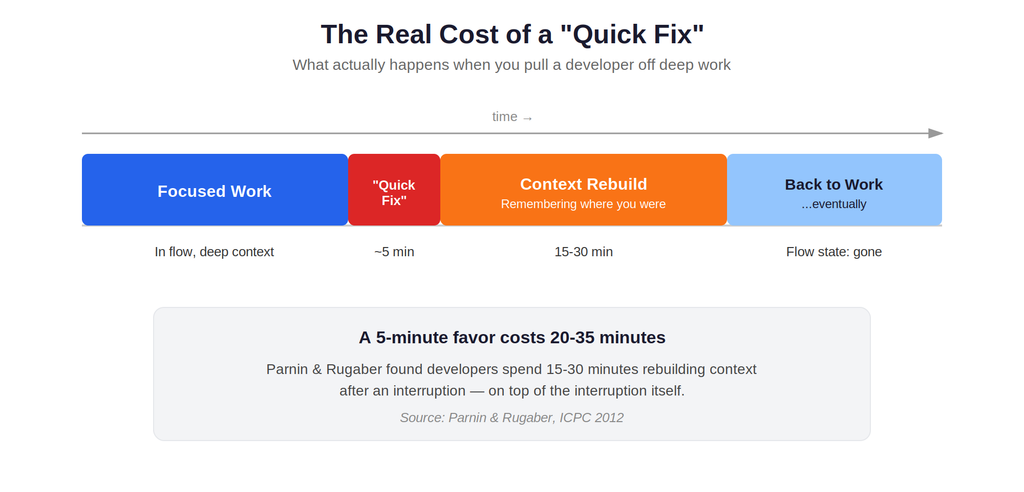
When someone says “hey, can you just quickly look at this,” they’re really asking for a five-minute favor. That favor carries a twenty-to-thirty-minute invoice. The next task quietly pays that invoice – in missed details and slower work that nobody bills back to the interruption.
The Research on Developer Context Switching
I went looking for actual studies on this. “I feel unproductive when I get interrupted” isn’t exactly a compelling argument to a skeptical manager. Turns out there’s a decent body of empirical software engineering research on developer context switching, and it all points the same direction:
- Interrupted tasks get abandoned. A study tracking 44,515 real tasks across 23 professional developers found that developers switch away from roughly 59% of their daily tasks. They never resume 29% of them. Not delayed. Gone.
- Frequency is the killer, not multitasking itself. Vasilescu et al. studied context-switching behavior across GitHub projects. Developers working across multiple projects can actually be more productive. But developers who switch frequently within a single day are measurably less productive. It’s not the breadth that hurts you – it’s the rate.
- It shows up as bugs, not just slower delivery. Amoroso d’Aragona et al. found that frequent breaks and interruptions correlate with more bugs, more technical debt, and lower code maintainability. Developers simply struggle to fully regain their prior cognitive context.
- Self-interruptions count too. The same 44,515-task study found something counterintuitive: developers switching tasks voluntarily hurts their own performance more than external interruptions do. So “I decided to jump over and help” doesn’t get you off the hook either – the cognitive cost is the same.
None of this is developers being precious about their flow state. It’s a measurable, repeated finding. Developer context switching has a real, quantifiable cost. That cost shows up as bugs, missed work, and burned time – not just bruised feelings.
The Interruption Debt Cycle: How Context Switching Compounds
Here’s where my story fits into the bigger picture. A single interruption is a bad but survivable event. The real damage compounds when it happens repeatedly on the same project, over weeks. Each switch adds a little more decay to context you never fully rebuilt from the last switch.
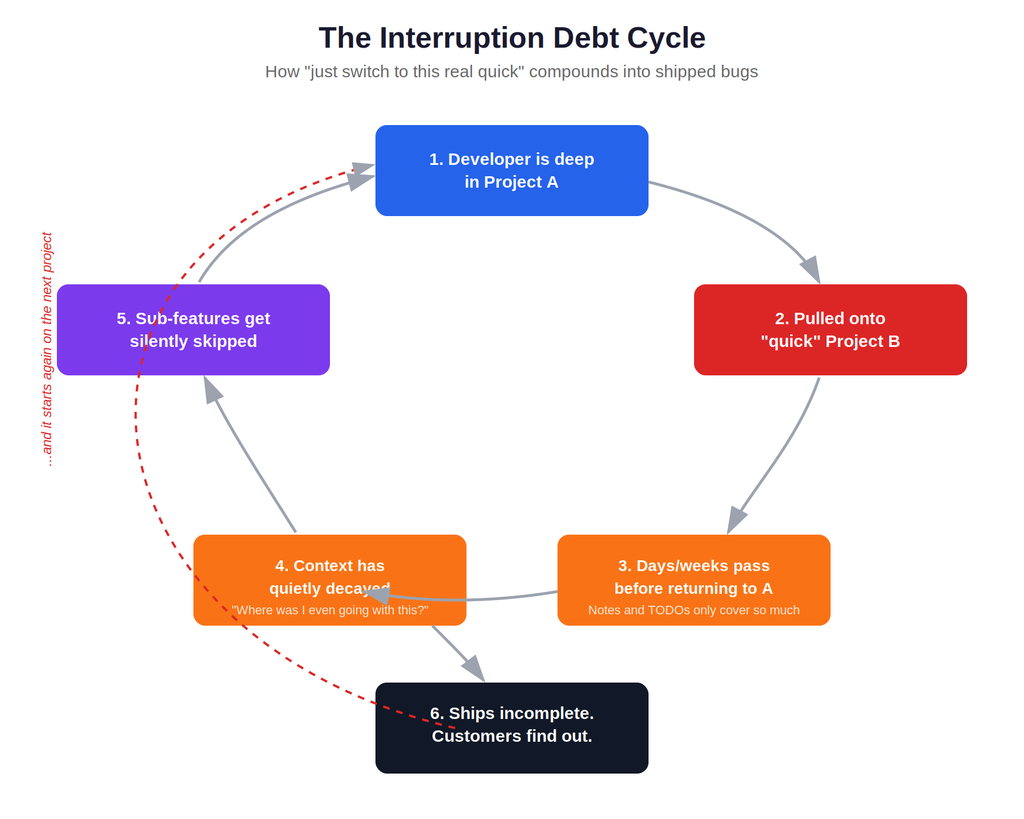
That’s exactly what happened to me. It wasn’t one interruption that tanked that project – it was dozens of interruptions across months. Each one shaved a little more off my mental model of what I’d already built and what was still left to do. TODOs and notes helped, but notes can only capture what you remember to write down. By month three, I wasn’t even sure what I’d forgotten. I didn’t skip those sub-features on purpose. They just quietly fell out of a context I’d rebuilt badly, one too many times.
This is the part that’s hard to see from the outside. Nobody scheduled “ship broken code” as a task. It happened as accumulated interest on a debt I took out five minutes at a time.
Reducing Developer Context Switching: What Actually Helps
I’m not going to pretend the answer is “never interrupt developers.” Some interruptions are legitimately urgent. Production is down. A customer is stuck. Whatever the reason, software development doesn’t happen in a vacuum, and pretending otherwise isn’t realistic – especially if you’re wearing as many hats as a full-stack developer tends to. But most of the developer context switching I’ve experienced wasn’t that urgent. It was priorities shifting because someone upstream didn’t want to wait.
A few things that actually move the needle, from both sides of the request.
If you’re the one being interrupted
- Write down more than feels necessary before you switch. Not just what you were doing – why, and what you were about to try next.
- Push back, respectfully, on same-day switches when you can. “I can start this at 2pm once I finish this piece” is a completely reasonable answer.
- If you get pulled off something for more than a day or two, budget explicit time to re-onboard yourself. Don’t assume you’ll just remember.
If you’re the one doing the interrupting
- Batch non-urgent requests instead of firing them off the moment they occur to you. A daily or twice-daily check-in absorbs most “quick things” without shattering anyone’s day.
- Ask “does this need to happen in the next hour, or just today?” Most things are the second one.
- If it truly is urgent, say so. Understand you’re not just buying five minutes of someone’s time. You’re buying the 20-30 minutes it takes them to get back to where they were.
Pair this with solid code review practices and it helps even more. The more context that lives in commit messages, PR descriptions, and review comments – instead of just one developer’s head – the less catastrophic any single context switch becomes.
The goal isn’t zero interruptions. It’s making the real cost visible enough that switching becomes a deliberate tradeoff, not a reflex.
Conclusion
“It’ll just take a minute” is one of the most expensive sentences in software development. It took an entire incomplete feature in production for me to really internalize why. Developer context switching isn’t a soft complaint about developers wanting to be left alone. It’s a documented, repeated finding across empirical software engineering research. Interruptions cost 15-30 minutes of recovery time. A third of switched tasks never get finished. The bugs from all that lost context show up in production, not in a status report.
Next time something feels like a “quick fix,” ask what it’s actually going to cost. The five minutes you’re asking for is rarely the real price.
References & Further Reading
- Parnin, C., & Rugaber, S. (2012). Programmer Information Needs After Memory Failure. ICPC 2012.
- Vasilescu, B., Blincoe, K., Xuan, Q., Casalnuovo, C., Damian, D., Devanbu, P., & Filkov, V. (2016). The Sky Is Not the Limit: Multitasking Across GitHub Projects. ICSE 2016.
- Amoroso d’Aragona, D., Pascarella, L., Janes, A., Lenarduzzi, V., & Peñaloza, R. (2023). Breaks and Code Quality: Investigating the Impact of Forgetting on Software Development. arXiv preprint.
- Task Interruption in Software Development Projects: What Makes Some Interruptions More Disruptive Than Others? – the 44,515-task study on self vs. external interruptions.
- Impact of Task Switching and Work Interruptions on Software Development Processes – ICSSP 2017.
- Breaking the Flow: A Study of Interruptions During Software Engineering Activities – ICSE 2024.
Credits
Photo by cottonbro studio: https://www.pexels.com/photo/close-up-shot-of-a-domino-and-hand-8102746/

Yes!
I was legitimately tasked with two separate projects running in agile at the same 2 week sprint schedule for months!
Oh, I told my manager, my project manager, and my co-devs on the same projects. “This is taking longer than just to allow me to work on one of these at a time.” I was ignored, rebuffed, or told that I needed “better time management skills”.
I told the internal teams that I was going to keep my context switching down by working the first week on project A, and the second week on project B. Good in theory, but when you have daily standups I had to answer, “Why is nothing getting done on my project?!” – Of course, my manager & project manager didn’t have the balls to tell them, well, you don’t get work done this week- that’s next week. So I had to abandon that strategy.
In the end…guess what happened? Yup! They got two products that had missing features or bugs that would never have happened if I was allowed to stay on one project to “deep think”.
I know it’s WAY Old, but I like this article too: https://www.paulgraham.com/makersschedule.html
Anyways Great Post as always!!!
Isn’t that aggravating? Same issue I’ve experienced and continue to experience. People just simply don’t believe the actual cost involved and even go as far to claim that we can’t prove it. That’s really where the impetus for the post came from — find studies that do prove it.
Am I salty? Probably. But did I find research backing it up? yes.